
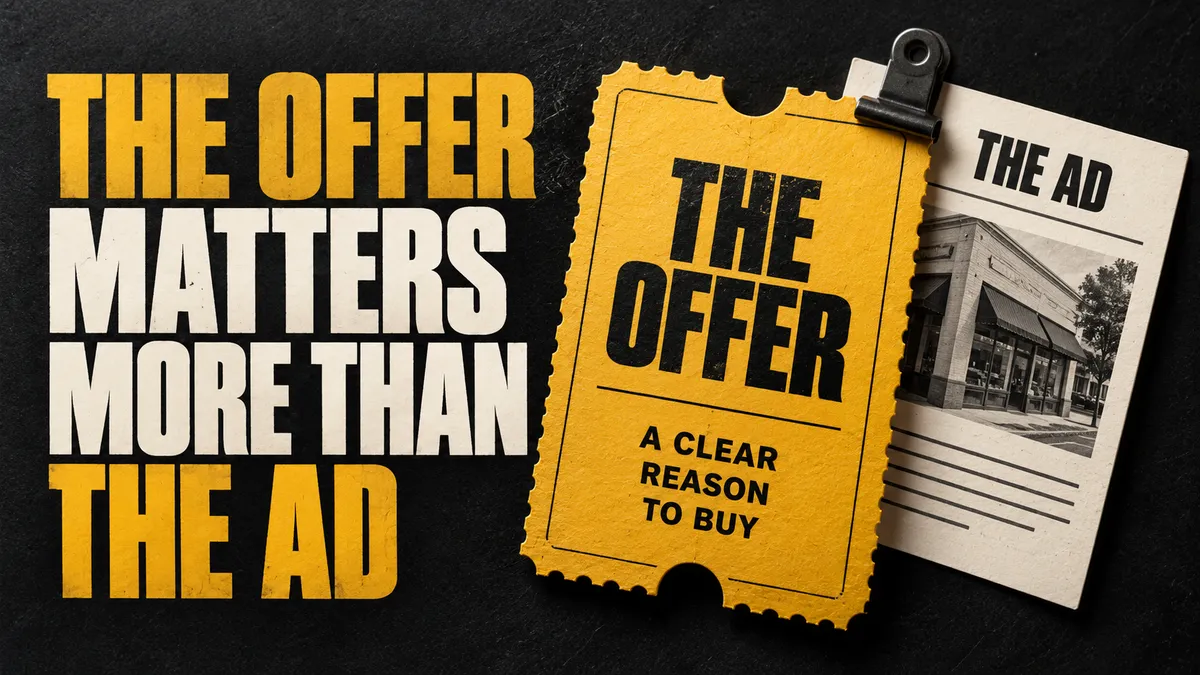
The offer matters more than the ad
When a campaign is not working, almost everybody looks at the ad first. New creative, different headline, better photo, another audience.
Often the ad is fine and nobody wants what is being offered at the price it is offered for. No amount of creative work fixes that, and the time spent trying is the most common way to waste a quarter.
The difference between a service and an offer
A service is what you do. An offer is a specific thing somebody can say yes to right now.
“Roof repairs” is a service. “Free roof check, booked this week, report sent same day” is an offer.
“Dental practice” is a service. “$59 new patient exam and clean” is an offer.
The second version in each case gives somebody something to decide about. The first asks them to work out what they want and start a conversation about it, which is more effort than most people will spend on an ad.
What makes an offer work
It is specific. A number, a timeframe, a defined scope. Vague offers get vague responses.
It is a small first step. Somebody has not met you. Asking them to commit to a $9,000 job from an advert is asking too much. Asking them to book a free assessment is not.
It removes the main risk. Whatever people are most worried about, the offer should address it. Price uncertainty, being sold to, wasting their time.
It has a reason to act now. Not false scarcity, which people see through. Real reasons: a season ending, capacity filling, a price changing.
You can actually deliver it. An offer you resent fulfilling produces a bad experience and a worse review.
How to tell the offer is the problem
A few signals, and they are fairly reliable.
Good click through, no inquiries. People found the ad interesting enough to click and then decided against. The ad did its job and the thing behind it did not.
You changed the creative three times and nothing moved. If three genuinely different creatives all produce the same poor result, the common factor is not the creative.
People inquire and then go quiet at the price. The offer is attracting people for whom it is not actually suitable.
Your close rate on these leads is far below your normal close rate. The offer is bringing in a different kind of person than your usual customers.
Testing an offer when you have no volume
You cannot A/B test an offer properly at local volume. The sample size needed to separate a small difference reliably runs into thousands of visitors per version, which most local businesses do not see in a year.
What you can do instead:
Run one offer for a month, then a genuinely different one for a month. Not a tweak, a different proposition. A difference big enough to see without statistics.
Ask the people who did not buy. Five phone calls to leads that went cold will tell you more than any amount of data at this volume.
Watch where they stop. If they inquire and vanish at the price, the price is the issue. If they never inquire, the proposition is.
Use your own sales calls. You already know the objection you hear most often. The offer should answer it before they have to raise it.
Offers that generally work for local businesses
A defined first step. Assessment, inspection, consultation, with a clear scope and timeframe.
A specific price on a specific thing. Not a discount on everything, a real price on one service people buy.
A guarantee on something you control. Arrival times, cleanliness, callback speed. Not results.
A bundled fix for a problem people have more than once.
Offers that usually do not
A percentage off. Ten percent off an unknown number is not information.
Free quote, on its own. Everybody says it, so it distinguishes nothing, and it attracts people collecting quotes rather than buying.
Anything requiring a long explanation. If it takes a paragraph, it will not survive a feed.
A discount that attracts the wrong customer. The cheapest offer brings the most price sensitive people, who are frequently the hardest to serve and the first to leave a bad review.
What we would do on a call
If a campaign is not producing, we look at the offer before the creative, because it is the cheaper thing to change and the more likely culprit.
Sometimes the honest answer is that the offer is fine and the market does not want it at that price, which is a business conversation rather than a marketing one. We would rather have that conversation than sell you another three months of creative testing.