
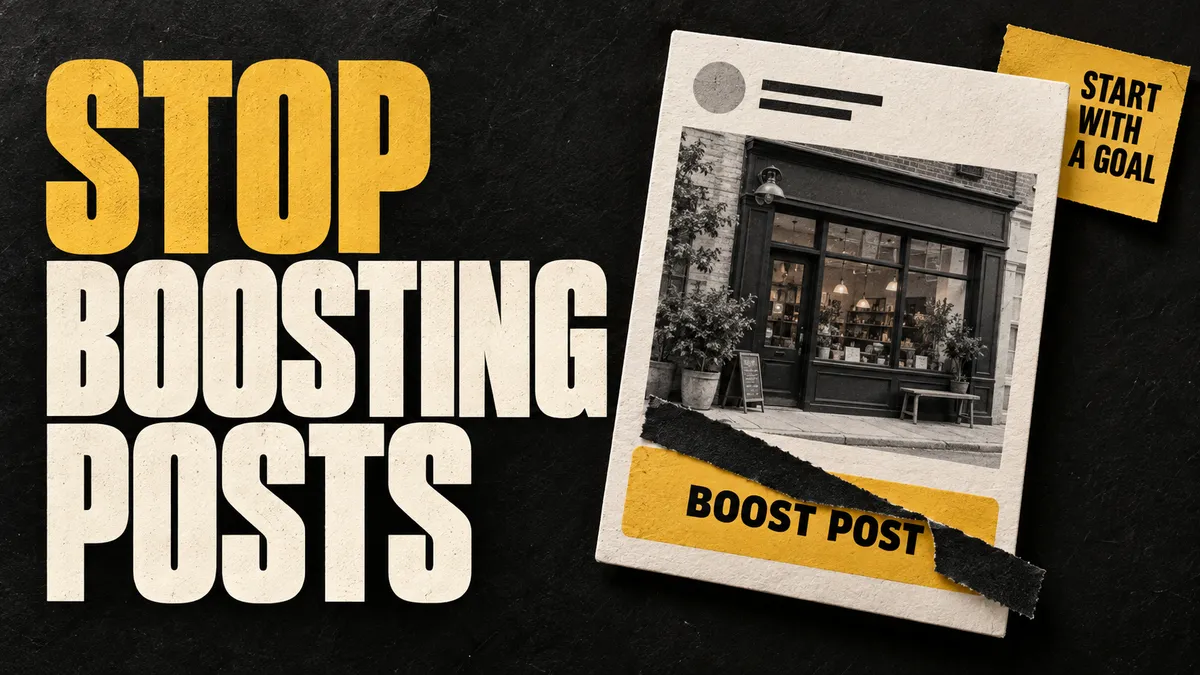
Stop boosting posts
The Boost Post button is the easiest money Meta has ever made. It is right there under something you have already published, it takes two taps, and it feels like doing marketing.
It is also, for almost every local business, the worst way to spend an advertising budget.
What boosting actually does
Boosting takes an existing organic post and pays to show it to more people. That is the entire mechanism.
What it does not do is most of what you would want. The objective is usually engagement, so Meta optimizes for likes, comments and shares rather than for anybody contacting you. The targeting options are a fraction of what is available in the full ad system. You cannot run proper creative variations, you cannot build a sensible audience structure, and you get very little useful reporting back.
You are paying for reach on a post that was written to be a post, not to produce a customer.
Why the results look fine and are not
A boosted post usually comes back with encouraging numbers. Lots of reach, a decent number of likes, a few comments.
Those numbers are real, they are just not connected to anything. Engagement is cheap to buy, because liking a post costs the viewer nothing. Meta can find enormous numbers of people who will tap a like and never think about you again, and if that is the goal you set, that is the goal it will hit.
The question worth asking after any boost is simple. How many people contacted you? Usually the answer is none, and the reason is that nothing in the setup asked for it.
Where the money should go instead
The same budget run through Ads Manager with a proper objective buys you something different.
A campaign built around one offer. Not a general post about your business, a specific thing somebody can say yes to.
Targeting worth the name. Your actual service area rather than a radius that includes places you will not drive to, with the ability to exclude people who have already contacted you.
Creative made for the job. An ad written to get a response reads differently from a post written to be seen. Shorter, clearer, with one thing to do next.
A destination that converts. A lead form or a landing page built for that offer, rather than a profile page or a homepage about everything.
Reporting you can act on. Cost per lead rather than cost per like. Which creative produced inquiries. What you spent and what came back.
None of that is available through the boost button, and none of it is exotic. It is just the normal way of running advertising.
The one case where boosting is defensible
If you have published something that is genuinely performing organically, people are commenting, sharing it, tagging others, then putting a small amount behind it to extend that reach is a reasonable thing to do.
That is amplifying something that already worked. It is not a strategy, and it is not lead generation. Treat it as what it is: a few dollars to get more out of a good post.
The failure mode is boosting everything on the assumption that paying makes an ordinary post into a good one. It does not. It makes an ordinary post into an ordinary post that more people ignored.
Why so many businesses do it anyway
Because the alternative looks hard. Ads Manager is genuinely intimidating the first time, the options are endless, and the boost button is designed to be the path of least resistance. Meta is not hiding it by accident.
There is also a feedback loop. Boosting produces visible numbers quickly, and the full ad system takes a couple of weeks to settle. If you judge both on week one, boosting looks better. If you judge both on whether the phone rang, it does not.
What we would say on a call
If you are boosting posts and getting inquiries from it, keep doing it. Nothing here is more important than what is actually working for you.
If you are boosting posts, seeing the engagement numbers, and not getting inquiries, the budget is not the problem and neither is the frequency. The objective is wrong, and no amount of boosting harder will fix an objective.
That usually means moving to proper campaigns, which is what we do. It occasionally means your offer is the problem and no campaign structure will rescue it, in which case we would rather tell you that before you spend anything with us.