
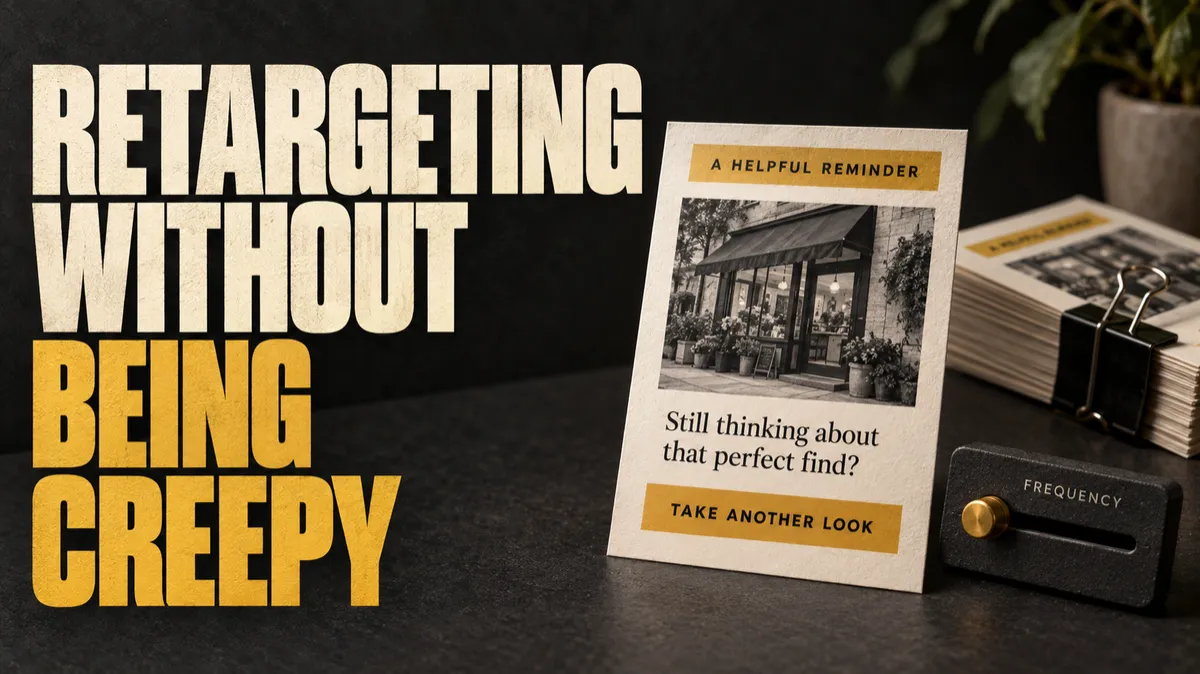
Retargeting without being creepy
Retargeting shows ads to people who already visited your website. It is one of the more effective things you can do with a small budget, and one of the easiest to overdo to the point where it damages you.
Why it works
Somebody who visited your site has already done the hard part. They found you, they were interested enough to click, and something stopped them going further. That could be a phone ringing, a child, a decision to think about it.
Showing them your name again a day later is a reminder rather than an introduction, and reminders convert better than introductions. The audience is small, the intent is high, and the cost per inquiry is usually the best in the account.
Where it goes wrong
No frequency cap. The same person sees the same ad nine times in four days, concludes you are following them, and now has a slightly negative association with your business. You paid for that.
No time limit. Somebody who looked at your site in March should not be seeing your ads in August. They either bought elsewhere or lost interest, and either way you are paying to annoy them.
Not excluding people who converted. The most common mistake. Somebody inquires, you book the job, and they spend the next fortnight being advertised to for the thing you are already doing for them. It looks disorganized because it is.
The same ad as the cold campaign. They have seen the introduction. Repeating it tells them you have not noticed they already engaged.
Sensible settings for a local business
Window of seven to fourteen days for most services. Urgent categories shorter, because somebody with a blocked drain has resolved it by day three. Considered purchases longer, up to thirty.
Frequency capped around two or three impressions a week. Enough to be remembered, not enough to be noticed as repetition.
Exclude converters. Anybody who filled in a form or called. This requires conversion tracking to actually be working, which is worth checking rather than assuming.
Exclude existing customers on anything acquisition focused. Advertising a new customer offer to somebody who has been with you three years is a small insult and it happens constantly.
A different message from the cold ad. They know who you are. The second ad can go straight to the specific thing: the offer, the reassurance, the answer to whatever stopped them.
What to actually say in a retargeting ad
The useful question is what stopped them, and the answer is usually one of four things.
Price uncertainty. Say a number. Even a range. “Most repairs are $200 to $450” removes the main reason people stall.
Timing. “Booking from next Tuesday” tells them the thing they wanted to know.
Trust. The reviews, the years, the insurance. Short, not a speech.
They got distracted. Nothing was wrong, life happened. A simple reminder with a phone number is enough.
You do not need to pick one. Three variants, one per objection, running together, and the platform will favor whichever gets responses.
The small audience problem
For a local business, the retargeting pool is genuinely small. A site getting four hundred visitors a month gives you a few hundred people to work with.
Two consequences follow.
The budget should be small. Five to ten dollars a day is usually plenty, and spending more just increases frequency on the same few hundred people, which is the thing you were trying to avoid.
And fatigue arrives fast. A small pool sees your creative quickly. Refresh it more often than you would on a cold campaign.
The privacy side
Browser restrictions and tracking changes have made retargeting less precise than it was. Audiences are smaller, matching is less reliable, and the numbers are softer than a few years ago.
It still works, it just works less well, and anybody describing retargeting the way it behaved in 2018 has not been paying attention.
Make sure your cookie notice and privacy policy actually reflect what you are doing. This is not just compliance. It is the part that makes the difference between retargeting that feels normal and retargeting that feels like surveillance.
The honest summary
Retargeting is a good use of a small amount of money, with a cap on it, excluding the people who already bought, running for a short window.
It is not a growth channel on its own. It can only re-reach people somebody else brought to the site, which means it amplifies whatever your acquisition is doing. If nobody is visiting, there is nobody to retarget.
Set it up, cap it, exclude properly, and leave it running quietly in the background. It is one of the few things in an ad account that does not need weekly attention.