
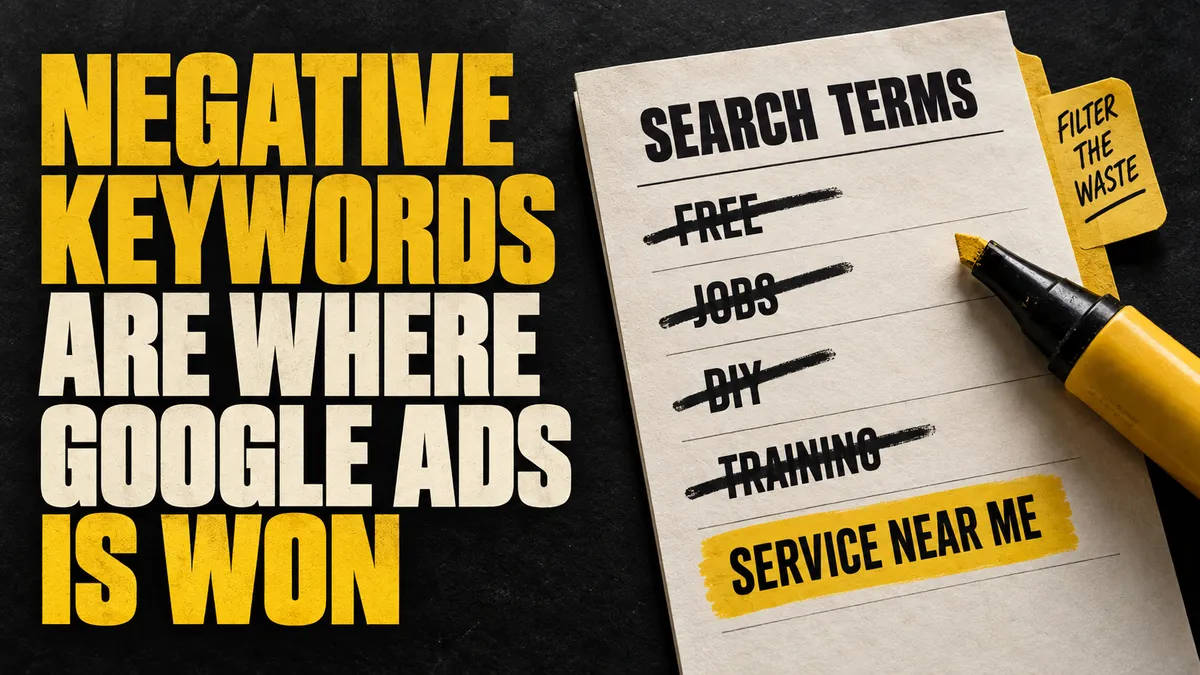
Negative keywords are where Google ads is won
Most people think running Google ads is about choosing the right keywords. It is mostly about removing the wrong ones, and the difference between a profitable account and a wasteful one is usually sitting in a report nobody opens.
What is actually happening when somebody clicks
You bid on a keyword. Google does not only show your ad for that exact phrase, it shows it for anything it considers related, and its definition of related is broader than yours.
Bid on “roof repair” and you can end up paying for “how to repair a roof yourself”, “roof repair cost calculator”, “roofing jobs near me” and “best roof repair videos”. Every one of those is a person who will never hire you, and every one of those clicks costs the same as a real one.
This is not Google misbehaving. It is the system working as designed, casting wide and letting you narrow it. The narrowing is your job, and if nobody does it, the waste compounds every week.
The search terms report
Everything you need is in one place: the search terms report, which shows what people actually typed before clicking your ad, as opposed to the keywords you bid on.
Open it. Sort by cost. Read the top thirty.
Most people doing this for the first time have the same reaction, which is that a meaningful share of their spend went to searches they would never have chosen. Jobs. DIY. Free. Students. Other cities. Competitor names. People researching rather than buying.
That is the money you get back.
The categories worth cutting first
Jobs and careers. “Roofing jobs”, “hiring”, “salary”, “apprenticeship”. Pure waste, and common in every trade.
DIY and how to. “How to”, “yourself”, “diy”, “tutorial”, “step by step”. Somebody learning to do it themselves is the opposite of a customer.
Free and cheap. “Free”, “cheapest”, “discount”, “second hand”. Occasionally you want these. Usually you do not.
Research and definition. “What is”, “meaning”, “examples”, “vs”. These are people reading, not buying.
Wrong geography. Place names outside your service area. This happens constantly even with location targeting, because Google will show your ad to somebody searching about a place rather than in it.
Adjacent services you do not offer. A plumber bidding broadly on “plumbing” picks up boiler installation, drain surveys and whatever else they do not do.
Competitor names, unless you have deliberately chosen to bid on them, which is a separate decision with its own arguments.
How to add them
Negative keywords can sit at account level, campaign level or ad group level. A shared account level list for the obvious categories, jobs, DIY, free, is worth building once and applying everywhere.
Match types matter here as much as they do on the positive side. A broad negative is a blunt instrument that can exclude more than you intended. Adding “free” as a broad negative removes anything containing the word free, which may include searches you want.
Start specific, review, and widen only where you are confident.
How often this needs doing
Weekly in the first month or two. The account is new, the terms are varied, and there is a lot to cut.
After that, every couple of weeks is usually enough, and it never stops entirely. New search terms appear constantly, and an account left alone for six months drifts back toward the waste it started with.
This is the single most honest answer to what an agency should be doing with your account on an ongoing basis. If somebody is charging you a monthly retainer for Google ads and cannot show you the negatives they have added recently, it is worth asking what they have been doing.
What this will not fix
A keyword list that is too broad to begin with. If you are bidding on single generic words, you will spend most of your time subtracting. Tighter keywords from the start means less remedial work.
A weak landing page. Cutting waste means the clicks you do pay for are more relevant. If they arrive somewhere that does not convert, you have simply bought better traffic for the same poor result.
A budget below the floor for your category. Pruning a campaign that cannot afford enough clicks to learn from does not rescue it.
The way to think about it
An account is not something you build and leave. It is something that silently gets worse unless somebody is removing things from it.
Most of the improvement in a Google account over its first six months comes from subtraction rather than addition. Less interesting than launching something new, and worth considerably more money.