
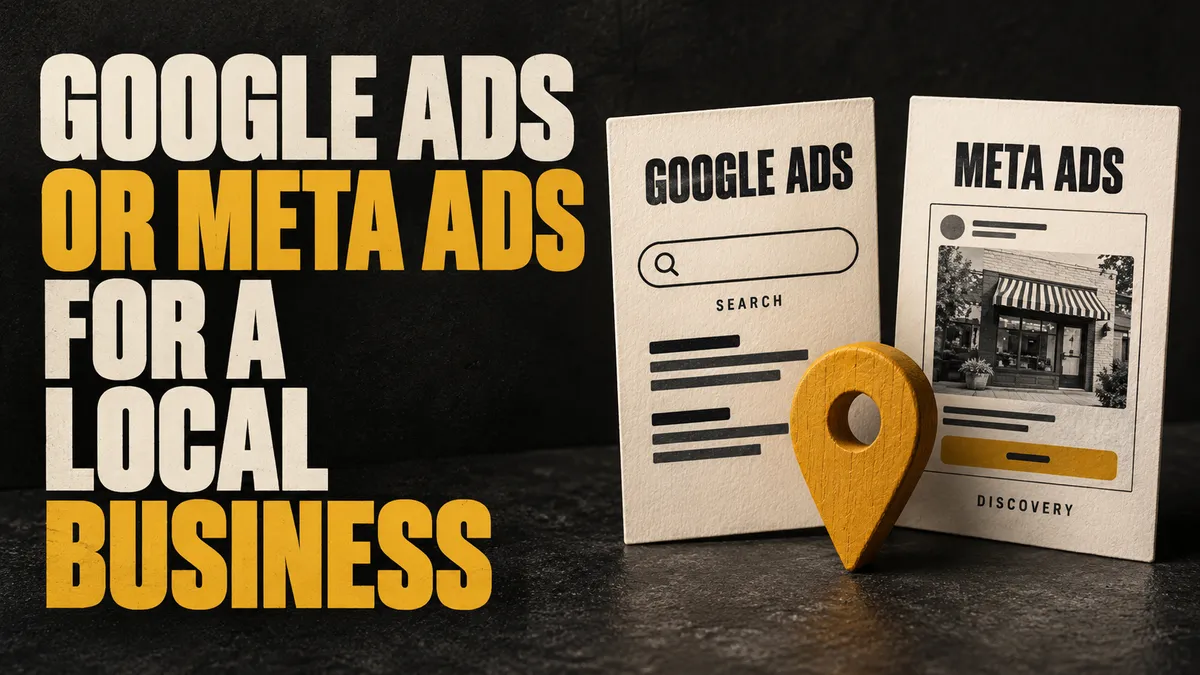
Google ads or Meta ads for a local business
These two do different jobs and the choice is less about which is better than about whether people are already looking for what you sell.
The actual difference
Google catches intent. Somebody has a problem, typed it into a search box, and is actively looking for a solution right now. You are paying to be in front of a person who already decided they need this.
Meta creates it. Somebody is scrolling and is not thinking about you at all. You are paying to interrupt them with something good enough to change that.
Everything else follows from this distinction. Intent is more expensive per click and converts better. Interruption is cheaper per click and converts worse, but reaches people who would never have searched.
When Google is the obvious choice
Urgent problems. Blocked drain, broken boiler, locked out, emergency dental, burst pipe. Nobody browses for these. They search, they call the first credible result, and the job is booked in four minutes.
Known services with a clear name. People search “roof repair” and “teeth whitening” because they know what the thing is called. If your service has a searchable name, people are searching for it.
High value, considered purchases. Legal services, large installations. The volume is low and the cost per click is high, but somebody searching for a personal injury lawyer is a serious prospect.
The test: open Google Keyword Planner and look up what you sell in your city. If there is meaningful monthly search volume, Google is on the table.
When Meta is the obvious choice
Services people do not search for. Med spa treatments, most aesthetic work, anything somebody did not know existed or had not considered yet. Nobody searches for a treatment they have not heard of.
Discretionary spending. Gyms, salons, restaurants, classes. People do not search for a new gym, they see one and think about it.
Visual work. Before and after transforms a scroll into an inquiry in a way that a text ad cannot.
Low search volume categories. If Keyword Planner shows forty searches a month in your area, Google cannot deliver volume no matter how well it is run.
When you need a bigger audience than intent provides. There are only so many people searching. Meta can reach everybody in your area regardless of what they are currently thinking about.
What it costs in practice
Google clicks cost more. Sometimes a lot more. Competitive trades in large metros can run twenty to thirty dollars a click, and emergency categories higher again.
Meta clicks are usually a fraction of that, often around a dollar for a local audience.
That looks decisive until you account for conversion. A thirty dollar Google click from somebody actively searching might convert at ten percent, giving a three hundred dollar lead. A one dollar Meta click might convert at two percent, giving a fifty dollar lead that is less likely to answer the phone.
Which is better depends entirely on what a customer is worth to you, which is why that arithmetic comes before this decision.
The budget threshold
Google needs a bigger minimum to work, because clicks cost more and you still need enough of them to learn from.
If a click costs you twenty five dollars, a twenty dollar daily budget buys you less than one click a day. That campaign cannot work and no management skill rescues it.
Meta’s cheaper clicks mean a smaller budget can still produce enough volume to be worth running. For businesses with limited budget in a competitive Google category, Meta is often the only one that can function.
Running both
Most established businesses eventually should, because they do different jobs and the combination is more stable than either alone.
A sensible order is to start with whichever one matches your category, prove it works, then add the other. Starting both at once with a budget that can only properly fund one means two campaigns that both struggle.
Our Meta management is $499 a month and Google is $599, which reflects that Google takes more ongoing work: search terms, negatives, bid management. We would usually recommend starting with one.
What we would ask on a call
What do people type when they want what you sell, and how many of them are typing it. If the answer is a real number, Google first. If people would not know what to search for, Meta first.
And what a customer is worth, because that decides whether an expensive click in a high intent category is affordable for you or not.
Those two questions settle it most of the time, and neither requires a salesperson.