
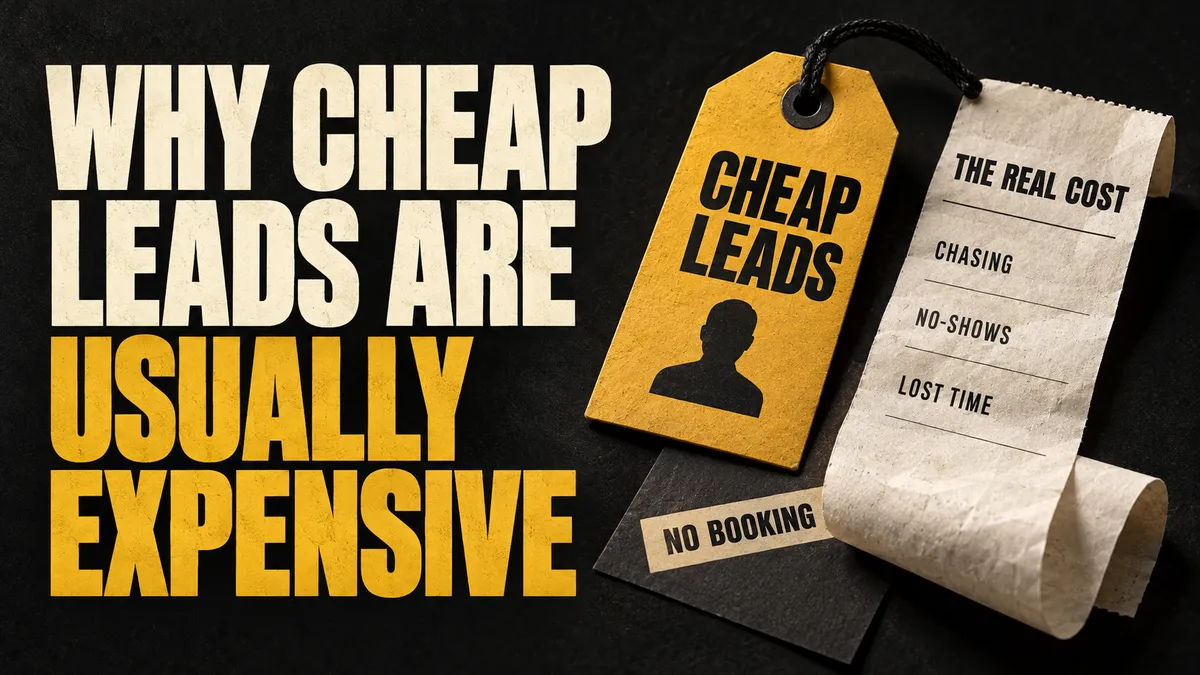
Why cheap leads are usually expensive
Driving cost per lead down is one of the easiest things to do in advertising. Broaden the targeting, loosen the qualification, promise something free, remove the questions from the form. The number on the report improves within days.
The business usually gets worse at the same time, and the report has no way of showing it.
How a cheap lead gets manufactured
Broaden the audience. Stop excluding people outside your area, outside your price range, or looking for something adjacent. More people see it, more people click, cost per lead falls.
Change the offer to something free. Free quote, free inspection, free consultation. Enormously more responses, and a large share of them from people who wanted the free thing rather than the paid one.
Strip the form. Remove the qualifying question. Now everybody completes it, including the people the question would have filtered out.
Optimize for the wrong event. Count form opens, link clicks or messages started as leads. The number explodes and means nothing.
Each of those is defensible in isolation and each of them lowers the number everybody is watching.
What it costs on your side
The cost moves rather than disappearing. It moves to you.
Every unqualified lead is a call you make, a quote you prepare, a site visit you drive to. Twenty minutes here, an hour there, and none of it shows up in the advertising report.
Sixty leads at $20 sounds better than twenty at $60. Both cost $1,200. If the sixty close at one in twenty and the twenty close at one in three, the first produces three customers and the second produces six, and the first also cost you about forty pointless phone calls.
The cheap option cost twice as much per customer and a week of your time.
The number that exposes it
Cost per acquired customer. Spend divided by customers won, not leads generated.
This is the figure that includes your close rate, and the close rate is where lead quality shows up. An agency can control cost per lead. Neither of you can fake cost per customer.
If cost per lead is falling and cost per customer is rising, you are watching quality degrade in real time. That pattern is common and almost never reported, because the first number is the one on the dashboard.
The other number worth watching
Contact rate. Of the leads that arrived, how many did you actually speak to?
Cheap leads often have poor contact rates, because the people generating them were not very interested to begin with. Somebody who tapped a button for a free thing is less likely to answer the phone than somebody who filled in a form about a specific job.
If your contact rate is falling while your cost per lead improves, that is the same story from a different angle.
When a cheap lead is genuinely fine
Not every cheap lead is bad, and it is worth being fair about this.
High volume, low value services where the job is quick and the qualification is simple. If the work takes an hour and anybody who calls is a candidate, volume is the right goal.
Categories where everybody converts. Emergency services, mostly. Somebody with a blocked drain at nine at night is not browsing.
When you have spare capacity. If the alternative is staff standing around, a lower quality lead you have time to chase is still better than nothing.
What makes it work in those cases is that the qualification cost is low. The problem is not cheap leads, it is cheap leads that take an hour each to disqualify.
What to ask for instead
Give an agency a target cost per acquired customer rather than a target cost per lead. It is harder to hit and much harder to game.
If they say they cannot be measured on it because they do not control your close rate, that is a fair objection. The answer is to agree a contact rate target as well, which they partly do control through lead quality, and to share your close rate with them monthly so the conversation is about the right number.
An agency that wants to know your close rate is an agency thinking about your business. One that only ever reports cost per lead is reporting the number easiest to improve.
The version we would be uncomfortable with
If you asked us to halve your cost per lead, we could. Broaden everything, switch the offer to a free inspection, cut the qualifying question. The next report would look excellent.
You would then spend your month on the phone to people who wanted a free inspection, and you would conclude in October that advertising does not work.
That is the trade, and it is worth naming out loud because the request is usually sincere. Cheaper leads sound like better value right up to the point where you count what happened to them.