
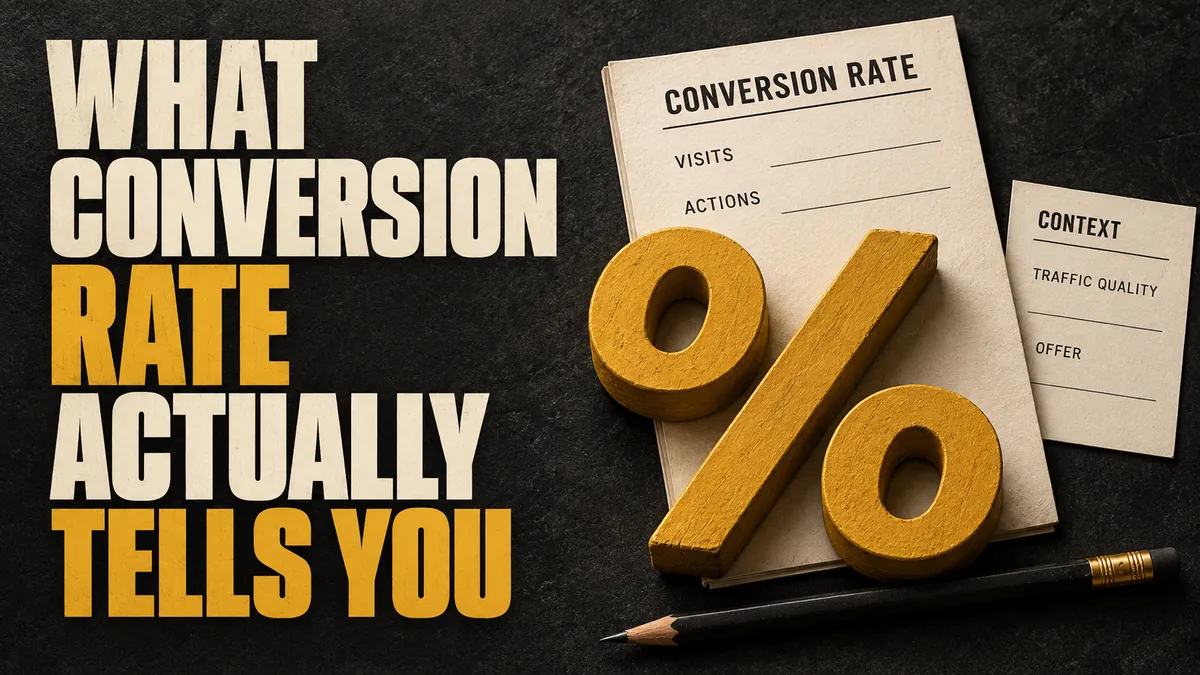
What conversion rate actually tells you
Conversion rate is the most quoted number in marketing and one of the most frequently misread. A percentage without a denominator is decoration, and most of the time the denominator is too small to mean anything.
What it is
The share of people who did the thing you wanted. Visitors who filled in a form. Clicks that became inquiries. Leads that became customers.
The trouble starts because all three of those get called conversion rate, often in the same conversation, and they measure completely different things.
Be specific about which one you mean. “Our conversion rate is four percent” is not a sentence that contains information until somebody says four percent of what.
The sample size problem
This is the part that matters most and gets discussed least.
A page with 50 visitors and 2 inquiries has a conversion rate of 4 percent. The honest range around that number, given 50 visitors, is roughly 1 to 14 percent. The true rate could be almost anything.
A page with 1,000 visitors and 40 inquiries also shows 4 percent, but the range is about 3 to 5.5. That is a number you can act on.
Same percentage, completely different reliability. Most local businesses are much closer to the first case, which means the percentage on their report is largely noise dressed up as insight.
The practical rule: below about a hundred conversions, treat the rate as a rough direction rather than a measurement. Above a few hundred, start believing it.
Why this matters for decisions
It matters because people change things based on these numbers.
A page goes from 4 percent to 3 percent and somebody rebuilds it. On 50 visitors a month, that drop is one inquiry, which is exactly the kind of variation you get from a holiday weekend.
The rebuild then shows 5 percent the following month, gets declared a success, and drifts back to 4 the month after. Nothing was learned and a page was rebuilt for no reason.
This is also why A/B testing rarely works at local volume. Detecting a one point difference reliably takes thousands of visitors per version, which most local businesses do not have in a year.
What to do instead
Look at longer windows. A quarter tells you more than a month, and three months of direction beats one month of precision.
Watch whole numbers alongside the percentage. Forty leads from a thousand visitors tells you more than four percent does, because you can immediately see whether the sample is worth anything.
Make big changes, not small ones. If you cannot measure a one point difference, do not spend time hunting one. Change the offer, not the button color.
Judge direction, not decimals. Up over three months, flat, or down. That is the resolution your data supports.
The conversion rates worth separating
Visitor to inquiry, on a landing page. This is the one most people mean and the one a landing page can actually improve.
Click to inquiry, on an ad campaign. Lower than the above, because it includes people who bounced immediately.
Inquiry to customer, your close rate. The most valuable of the three and the one nobody reports, because it depends on what your business does after the lead arrives.
That last one is the number that turns a cost per lead into a cost per customer, which is the only figure that tells you whether the money worked. If you track one thing, track that.
What a low rate usually means
The traffic is wrong. You are reaching people who were never going to buy. Check what search terms triggered your ads, or who the audience actually was.
The offer is wrong. The page is clear, the traffic is right, and people are reading it and deciding against. That is useful information and it is not a design problem.
The page is asking too much. Nine form fields, no phone number, a quote request that requires a survey. Every extra step costs you people.
The promise did not match. The ad said one thing and the page said another, so people assumed they were in the wrong place.
The honest limit
Conversion rate tells you what share of people did something. It cannot tell you whether those people were worth having.
A page that converts at ten percent by promising free quotes to anybody will produce more leads and worse business than one converting at three percent with a qualifying question in the form.
That is why conversion rate is a diagnostic rather than a target. The target is cost per acquired customer. Everything else is a clue about where to look.