
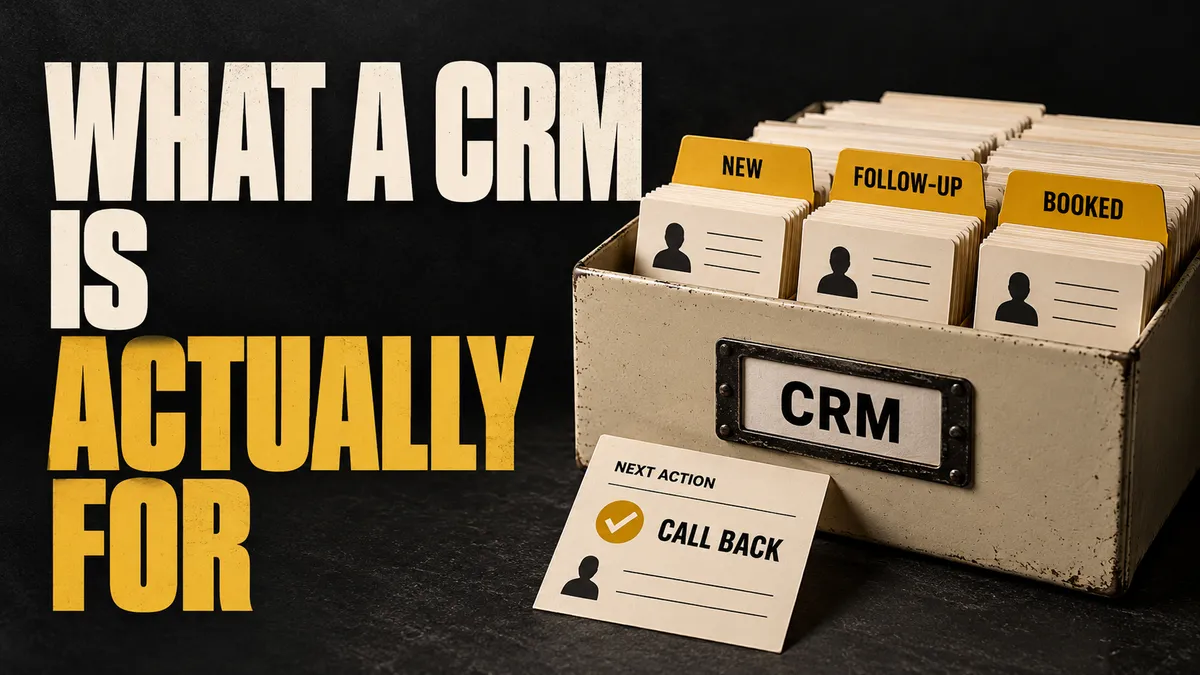
What a CRM is actually for
CRM stands for customer relationship management, which tells you nothing. For a local business the useful definition is narrower: it is the thing that makes sure nobody who contacted you gets forgotten.
That is the whole job. Everything else is optional.
The problem it solves
Inquiries arrive in five or six places. A form on the website. Facebook messages. Instagram messages. Texts to a mobile. Calls that went to voicemail. Someone who emailed the address on the van.
Each of those lives in a different app, on a different device, checked by a different person at a different frequency. At least one of them is not being checked at all.
So the leak is not that somebody decided to ignore a customer. It is that the message arrived somewhere nobody was looking, and there is no single place that would have shown it.
A CRM is that single place. Everything lands in one inbox, nothing depends on somebody remembering to check a particular app, and anybody can see what has happened with a given person.
What it needs to do for a local business
One inbox for every channel. Calls, texts, forms, Facebook, Instagram, email. If a channel is outside the system, it is the one that will be missed.
A record of what happened. Who contacted you, when, what about, what was said, what happens next. Enough that somebody else could pick it up.
A way to see who has not been dealt with. The single most useful view in the whole system. Everybody who contacted you and has not been answered.
Automatic first response. Acknowledge within seconds so the person knows you exist while they are still deciding.
A calendar that bookings land in. Not a separate system somebody copies across by hand.
Reminders. Both for you to follow up and for the customer not to forget the appointment.
That is six things and it covers the vast majority of what a local service business needs.
What you can safely ignore
Most CRMs sell a lot more than the above, and for a business with three staff almost none of it earns its keep.
Elaborate pipeline stages. Seven stages with probability weightings is a system designed for enterprise sales teams. For local work, you need something like: new, spoken to, quoted, booked, done, lost.
Lead scoring. You know which leads are good. You talked to them.
Complex automation chains. The temptation is to build a twelve step sequence. In practice two or three messages do almost all the work and the rest annoys people.
Forecasting and dashboards. For a business doing a few dozen jobs a month, a dashboard is decoration. You can hold the number in your head.
Buying a system for the features you will not use is the main way businesses end up paying for something nobody opens.
Why most CRM rollouts fail
Not the software. The habit.
The system gets set up, used properly for three weeks, then a busy fortnight arrives and somebody answers a customer directly from their phone without logging it. Then somebody else does. Within two months the CRM contains a partial record and nobody trusts it, which means nobody uses it.
The way through is to make the CRM the path of least resistance rather than an extra step. If replying through the system is easier than replying from your phone, it gets used. If it is an additional thing to do after you have already replied, it does not.
That is why the one inbox matters so much. It is not a reporting feature, it is what makes the habit survive a busy week.
What it will not do
It will not call anybody. The system can acknowledge, book and remind. It cannot have the conversation that wins the work.
It will not qualify leads for you. It can ask a question on a form. It cannot judge whether the job is worth your time.
It will not fix a slow response. A CRM shows you an unanswered inquiry. Somebody still has to answer it.
It will not make bad leads good. If the advertising is reaching the wrong people, organizing them better does not help.
What ours is
Lead capture and CRM at $250 a month, or included in the Meta Bundle. One inbox for every channel, automatic first reply within seconds inside the hours you set, bookings straight onto your calendar, quiet leads followed up, and non responders flagged with their phone number for you to call.
It is included in both bundles, and it can be added to Meta message ads separately.
What it is not is a sales team. We handle getting the inquiry answered and booked. The call is yours, and that is deliberate.
If you take one thing
If you do nothing else, put every channel into one inbox and decide who owns it.
That single change recovers more lost inquiries than any feature on any comparison chart, and you can do it with almost any system, including ones you already pay for.