
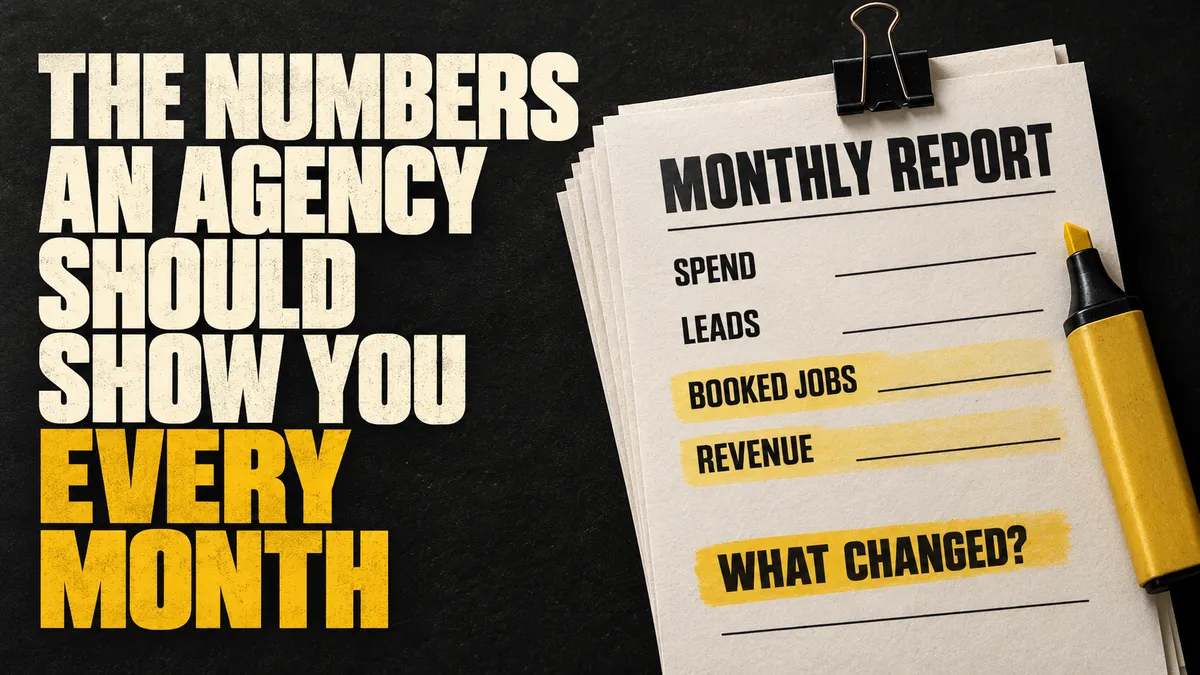
The numbers an agency should show you every month
A monthly report should answer one question: did the money work. Most do not, because they are built to fill a meeting rather than to be read.
Here is what belongs in one, what does not, and what the padding is usually hiding.
The six lines that matter
What you spent. Ad spend and fees, separated. You should always be able to see what went to the platform and what went to the agency.
How many inquiries arrived. A whole number, not a percentage.
Cost per lead. Spend divided by inquiries. Only meaningful against a target you worked out from your own margins.
How that compares with the previous two months. One month in isolation tells you almost nothing. Three months shows direction.
What changed in the account this month. Specifically. New negatives, creative refreshed, budget moved, audience adjusted. If nothing changed, the report should say so rather than implying activity.
What changes next month, and why.
Six lines. If a report runs to twelve slides and does not clearly contain those, the slides are doing something other than informing you.
The number you have to supply
How many of those leads became customers.
The agency cannot know this. Only you can, and without it nobody can calculate cost per acquired customer, which is the only figure that actually tells you whether the money worked.
Cost per lead is what the advertising did. Cost per customer includes what your business did with it. The gap between them is your contact rate and your close rate, and that is where most of the useful information lives.
Even a rough count at the end of each month, from memory, changes what every other number means. An agency that asks you for it is thinking about your business rather than their report.
What the padding usually hides
Impressions. How many times an ad was displayed. Enormous, trivially inflated, connected to nothing. A report that leads with impressions is a report avoiding the subject.
Reach, in a lead campaign. Reach is the point in an awareness campaign. In a campaign meant to produce inquiries it is a consolation prize.
Engagement. Likes, comments, shares. Cheap to buy and disconnected from revenue for almost every local business.
Click through rate on its own. A diagnostic, not a result. High CTR with no leads means the ad was interesting and the offer was not.
Follower growth, in a report about lead generation. Different objective, different campaign, different conversation.
None of those are lies. They are true numbers presented in place of the ones that matter, and the tell is when they appear first.
Three questions to ask about any report
What would this look like if the month had gone badly?
If you cannot imagine it looking different, it is not a report, it is a reassurance. A good report can clearly show a bad month.
What did you change, and what happened as a result?
Ongoing optimization means nothing. Ask what was actually done.
What is the one thing you are worried about?
Every account has something. Rising frequency, a creative getting tired, a keyword eating budget. An agency that never raises a concern is either not looking or not telling you.
What a good report looks like when things go wrong
This is the real test.
A good agency sends a report in a bad month that says: cost per lead rose from $64 to $91, we believe it is creative fatigue because frequency climbed to 4.2, we are replacing all three creatives this week, and if it has not recovered by the end of next month we should talk about whether the offer needs changing.
That is a report somebody can act on. It names the number, gives the likely cause, states the fix, and sets a point at which the conversation changes.
The alternative is a month of impressions and reach with a note that performance was steady.
The frequency question
Monthly is right for most local accounts. Weekly reporting on a business getting thirty leads a month produces mostly noise, and it encourages reacting to variation that means nothing.
What should be available at any time is the live account, which you should have access to regardless of who manages it. A report is a summary, not a substitute for being able to look.
The thing worth insisting on
Access to your own ad account, as an admin, from day one.
Not because you will check it daily, but because an agency that runs campaigns in an account you cannot see is asking for a level of trust nobody has earned in month one. It also means that if you leave, the history and the learning go with you.
Everything else on this page is a preference. That one is not.