
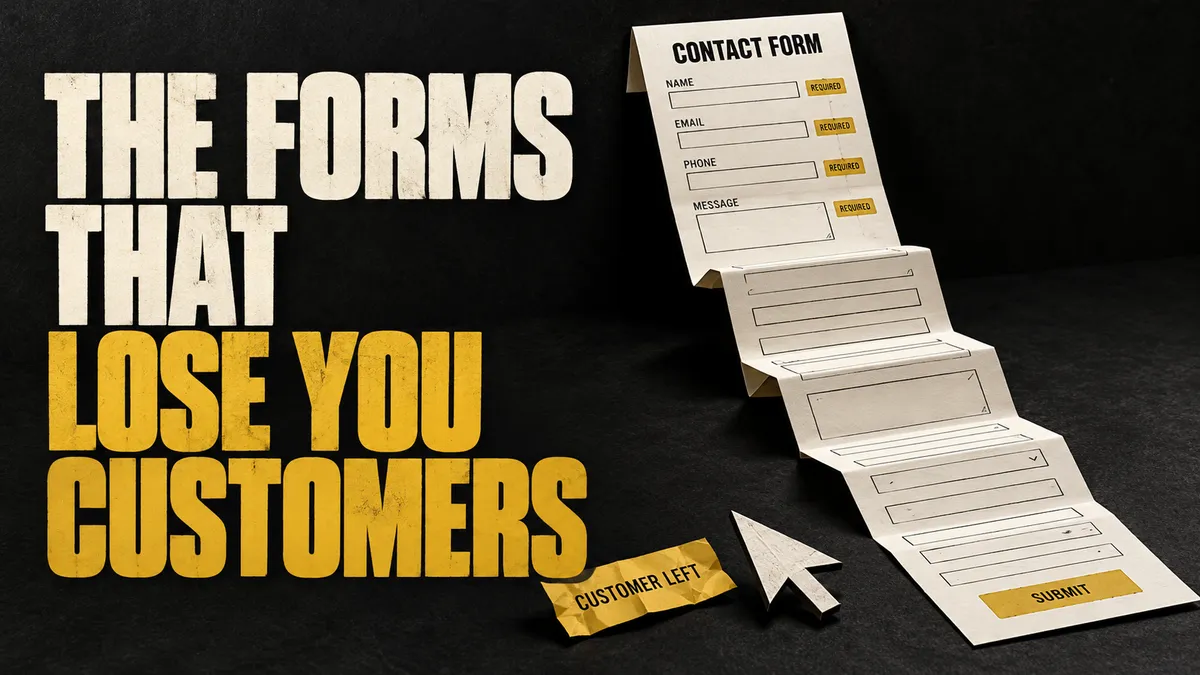
The forms that lose you customers
Somebody has read enough, decided to get in touch, and clicked the button. They are as close to becoming a customer as they will ever be without speaking to you.
Then they meet nine fields, a dropdown with twelve options, a captcha and a required message box.
A meaningful share of them leave, and you paid for every one of them to get there.
The rule
Every field costs you completions. Not a theory, just a consequence of asking somebody to do more work at the exact moment they were ready to stop thinking.
This does not mean the shortest form always wins, which is the oversimplified version. It means every field has to earn its place by being worth more than the people it costs you.
What to actually ask for
Name. First name is enough. Asking for both as separate required fields is two fields where one would do.
Phone number. For almost every local service business, this is the one that matters. You are going to call them.
One qualifying question. The single thing that changes how you respond. For a roofer, is it leaking now. For a dentist, is this an emergency. For a landscaper, roughly how big is the garden.
That is three fields and it is enough to have a useful first conversation.
What to cut
Email, if you are going to phone them. Collect it on the call. Asking for both phone and email when you only use one is a field that costs you people for nothing.
Address. You can get this on the call, and asking a stranger for their address before any contact feels intrusive.
A required message box. This is the biggest single killer. People stare at an empty box, cannot think what to write, and leave. Make it optional or remove it.
Dropdowns with many options. Each one is a decision you have forced somebody to make before they understand their own options. If you genuinely offer twelve services, that is twelve landing pages, not one dropdown.
Preferred contact time. You will phone them when you phone them.
How did you hear about us. Useful for you, worthless to them, and placed exactly where it costs you a completion. Ask on the call.
The captcha question
Captchas stop some spam and cost you some real people. Both are true and the balance depends on how much spam you are actually getting.
If you are getting a few junk submissions a week, deleting them takes less time than the customers a captcha costs you. If you are drowning in automated spam, use the invisible kind rather than the one that makes people identify traffic lights.
Never use a visible puzzle on a mobile form. The failure rate on a phone, one handed, in a hurry, is high enough to matter.
Things that have nothing to do with fields
Put your phone number above the form. A meaningful share of people would rather call. Making them fill in a form to reach you converts some of them into nobody.
Make the button say what happens. “Get a callback” beats “Submit”. People hesitate over verbs they do not understand the consequences of.
Say when you will respond. “We call back within the hour during business hours” removes the main reason people hesitate, which is wondering whether anybody is actually there.
Do not break it on mobile. Test it on a real phone, one handed. Most forms are designed on a desktop and used on a phone.
Confirm the submission properly. A page that just reloads leaves people wondering whether it worked, so they fill it in again, and now you have two leads and one annoyed person.
The one argument for a longer form
Longer forms produce fewer, better qualified leads. That is a real trade and sometimes the right one.
If your time is the constraint, and every unqualified call costs you twenty minutes, a form with three qualifying questions is doing useful work by filtering people out before they reach you.
If you have capacity and want volume, strip it back.
What is not defensible is a long form by accident, which is what most of them are. Nobody decided to ask nine questions. The form grew a field at a time because somebody wanted to know something.
The test
Open your own form on your phone, as a stranger would, and fill it in honestly.
If it takes more than about twenty seconds or you find yourself pausing to think, it is costing you customers. That is the whole test, and it takes less time than reading this.