
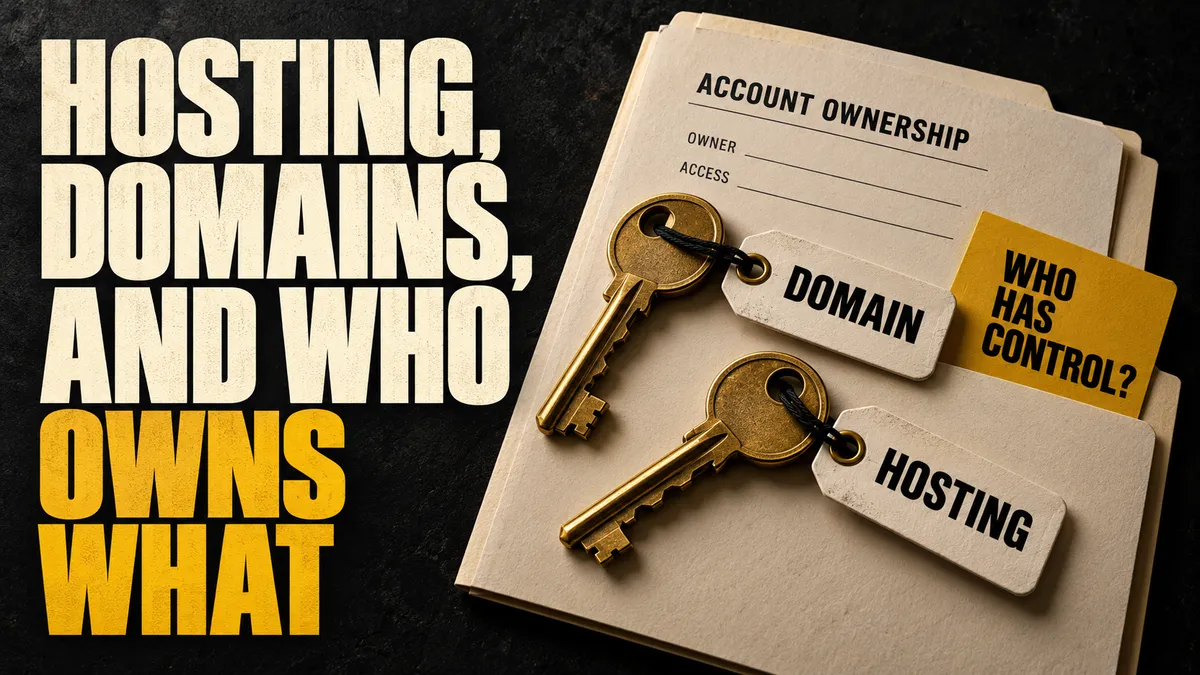
Hosting, domains, and who owns what
The worst version of this conversation happens two years after the website was built, when somebody needs a phone number changed and nobody can work out who has the login.
Here are the questions to ask before anybody builds you anything.
The three things that get confused
The domain. The address itself, yoursite.com. Rented annually from a registrar.
The hosting. The computer the site actually runs on, paid monthly or annually.
The build. The design and the pages. Usually a one off piece of work.
These are three separate things and they can sit with three different people. Most of the trouble comes from assuming they are one thing because one invoice covered them.
The questions to ask
Whose name is the domain registered in?
Yours. Not the agency’s, not the developer’s, not their company. If somebody registers it for you, you should appear as the registrant and have the login.
This is the single most important one. The domain is the only part that is genuinely irreplaceable. You can rebuild a site, you can move hosts, but if somebody else owns the address and you fall out, you are starting again from a new address with no search history and printed materials that point somewhere you no longer control.
Who holds the registrar login?
You should, even if somebody else manages it day to day. “They look after it” is not the same as having access.
Where is the site hosted and can I move it?
Some builders host on their own system, which is fine, provided you can export the content and leave. Ask directly what happens if you cancel, and get the answer before you commit.
Do I get the files?
For a custom built site, yes. For a site built on a platform, usually not in a usable form, because the platform is part of how it works. That is a reasonable trade and it should be stated rather than discovered.
Who owns the content?
Text, photos, logos. Yours, assuming you commissioned them. Stock images can carry licenses attached to the agency’s account rather than yours, which is worth asking about.
What happens to my email?
Business email often runs on the same domain. Losing control of the domain means losing your email, which is considerably worse than losing a website.
What hosting actually is and what it costs
A website needs to live on a machine that is always on. That is hosting, and for a small business site the real cost is modest.
Ours is $39 a month, which covers the server, the SSL certificate, backups and keeping it running. That is a normal price for managed hosting of a small site. You can find cheaper unmanaged hosting, and you will then be the person dealing with it when something breaks.
What is worth questioning is hosting bundled into a large monthly fee without a breakdown. If you are paying several hundred a month for a static brochure site, ask what the hosting portion is and what else the money buys.
When hosting stops
If you stop paying for hosting, the site goes down. That is not a penalty, it is how hosting works everywhere.
What should happen is that your domain remains yours, your content is exported to you on request, and nothing is held hostage. Ask what the notice period is and whether you get an export. Get it in writing.
Our position is that we export your content whenever you ask and the domain is always in your name, including if you leave. That should be unremarkable and it is worth confirming with anybody, including us.
The warning signs
The domain is registered to the agency. Fix this now, not later.
You have never had a login to anything. Ask for them. An agency that resists is telling you something.
Nobody can tell you where the site is hosted. Common with sites that changed hands a few times, and it needs resolving before anything else.
Renewals go to somebody else’s email. The day a domain expires because the reminder went to a former contractor is a bad day.
The person who built it has disappeared. More common than you would think, and the reason to own the domain yourself regardless of who builds anything.
The ten minute job worth doing today
Log into your registrar. If you cannot, that is the problem and finding out now is better than finding out in a crisis.
Check the registrant name is your business. Check the renewal date and that auto renew is on. Check the contact email is one you actually read.
That is it. Most businesses have never done it, and it is the difference between an inconvenience and a genuine emergency.