
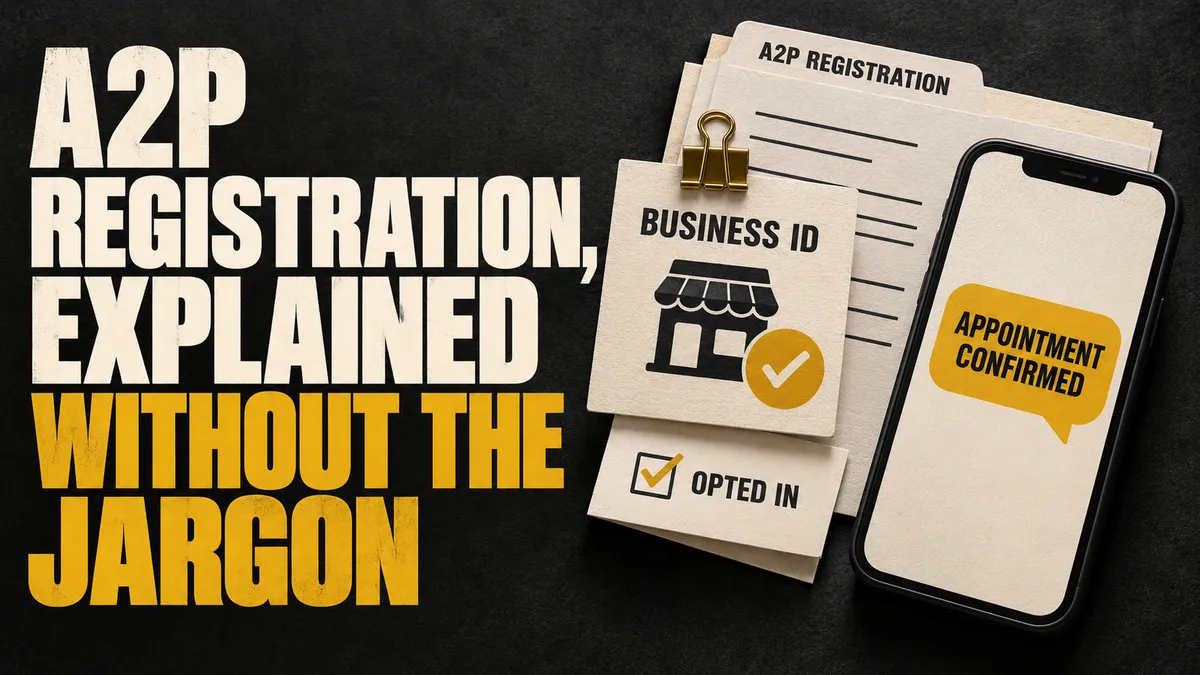
A2P registration, explained without the jargon
If you want to text customers from a business number in the United States or Canada, you now have to register to do it. The paperwork is called A2P 10DLC, nobody explains it clearly, and businesses regularly discover it exists only when their messages stop arriving.
Here is the plain version.
What it is
A2P means application to person: messages sent by software rather than typed by a human on a handset. 10DLC means ten digit long code, which is an ordinary local phone number as opposed to a short code.
So A2P 10DLC is the system that governs businesses sending automated texts from normal looking local numbers.
The carriers, meaning the phone networks, built it to cut down on spam. Before it existed, anybody could pump messages through a local number and the networks had no way to tell a plumber confirming an appointment from a scam operation.
Why it affects you
If any part of your business sends a text that was not typed by a person in the moment, you are in scope. Appointment reminders. Missed call text back. Follow up sequences. Confirmations from a booking system.
Without registration, carriers increasingly filter or block those messages. The worst part is that it usually fails silently. Your system shows the message as sent, the customer never receives it, and nobody finds out until somebody misses an appointment.
What the process involves
You register your business. Legal name, address, EIN or business number, website, contact details. The information has to match your public records, and mismatches are the most common cause of rejection.
You register a campaign. This is the carriers asking what kind of messages you will send and how people consent to receive them. You describe the use case, provide sample messages, and show where on your site people opt in.
You wait. Usually days rather than weeks, sometimes longer if something needs correcting.
You pay. There is a one time registration fee and a small recurring monthly campaign fee. These are set and taken by the carriers, not by your software provider, and nobody can waive them.
The part that trips businesses up
The consent evidence. Carriers want to see where and how somebody agreed to be texted.
In practice that means your website needs a privacy policy and terms that mention SMS, your forms need consent language near the submit button, and the language has to say who is messaging, what about, that message and data rates may apply, and how to stop.
If those pages do not exist or do not mention texting, registration gets rejected. This catches out a lot of businesses who assumed it was a phone system question rather than a website question.
It is also why we built the SMS sections of our terms and privacy pages before launching anything that sends messages. Not because they are interesting, but because the registration depends on them.
What you must keep doing afterwards
Registration is not a one time clearance.
Honor STOP immediately. Somebody replying STOP must be removed, automatically and permanently. This is not optional and it is not a judgement call.
Reply to HELP with who you are and how to contact you.
Only message people who opted in. Buying a list and texting it is the fastest way to lose your registration and your number.
Keep to sensible hours. There are legal restrictions on messaging times and carriers take a dim view regardless.
Keep the record. If somebody complains, you need to be able to show when and how they consented.
What it costs, roughly
A one time registration fee and a monthly campaign fee, both modest, both set by the carriers. Then message usage, which is metered per message sent and received.
We pass all of this through at cost. We do not mark it up and we could not refund it if we wanted to, because it is not our money. It is worth asking any provider whether they add a margin to carrier fees, because some do.
The honest summary
It is paperwork, it is dull, and it is not optional if you want automated texting to actually arrive. The registration itself is an afternoon if your details are in order and your website has the right pages.
The failure mode is not getting fined. It is your messages quietly not being delivered while your system tells you they were. That is why it is worth doing properly rather than finding out through a missed appointment.
We handle the registration as part of lead capture and CRM. The fees are yours and go straight to the carriers, and we will tell you what they are before you commit to anything.